
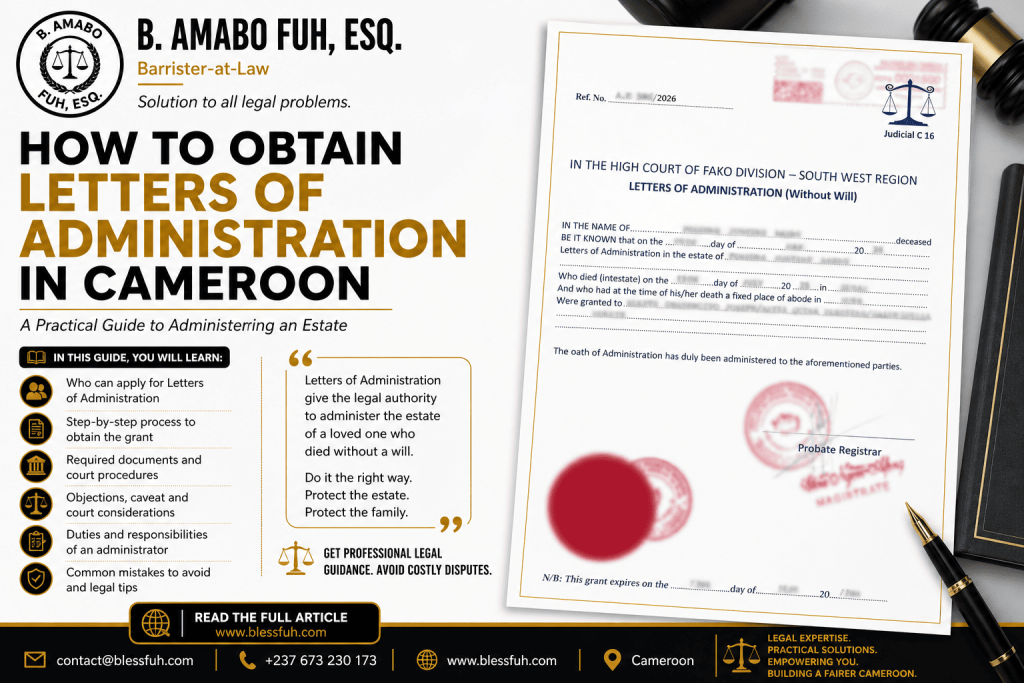
How to Obtain Letters of Administration in Cameroon
When a person dies without leaving a valid Will in Cameroon, their family may need to obtain Letters of Administration before certain assets of the deceased can be legally collected, managed, transferred or distributed.
Letters of Administration gives the person(s) appointed by the competent court the legal authority to administer the estate of the deceased. The process can involve identifying the lawful beneficiaries, establishing the next of kin, preparing an inventory of the deceased’s assets and liabilities, notifying interested persons, and satisfying the requirements of the Probate Court.
In Cameroon, succession law, which falls under family law, is particularly important because the country operates a bijural legal system. The procedure applicable to an estate may depend, among other things, on the region, the deceased’s personal and family circumstances, whether there is a Will, the nature of the property involved and the legal regime applicable to the succession.
This article explains how to obtain Letters of Administration in Cameroon, the documents generally required, who may apply, the steps involved and some of the common problems families encounter during estate administration.
What is Letters of Administration in Cameroon?
Letters of Administration is a legal grant authorising an administrator to represent and administer the estate of a deceased person.
They are particularly relevant where the deceased died intestate, meaning that the deceased died without a valid Will appointing an executor capable of obtaining probate.
The administrator may, subject to the authority of the court and the applicable succession law, be required to:
- identify and preserve the assets of the estate;
- collect money and other property belonging to the deceased;
- deal with banks and other institutions;
- pay lawful debts and liabilities of the estate;
- protect or manage immovable property;
- take steps concerning the deceased’s business interests;
- represent the estate in legal proceedings where necessary; and
- distribute the estate to the persons legally entitled to inherit.
Letters of Administration should therefore not be confused with a document that simply proves who the heirs are. The grant principally concerns the authority to administer the estate.
Matters concerning access to a deceased person’s property are treated as probate matters and are dealt with through the appropriate probate jurisdiction.
When is Letters of Administration Required in Cameroon?
Letters of Administration are generally relevant where a person dies without a valid Will or where there is no executor able or willing to administer the estate.
For example, a family may need letters of administration in Cameroon when the deceased left:
- Money in a bank account;
- Land or other immovable property;
- Vehicles;
- Shares in a company;
- Insurance or pension benefits;
- Personal belongings of significant value; or
- Debts owed to the deceased.
The death of the owner does not automatically give one family member(s)unrestricted authority to deal with the assets of the deceased.
Where a bank, company, land authority or other institution requires proof of authority to deal with the deceased’s property, the administrator may need to produce letters of administration.
Letters of Administration in Cameroon and Probate: What Is the Difference?
The distinction is important.
Probate generally concerns the validation of a Will and the authority of an executor appointed under the Will.
Letters of Administration, on the other hand, generally concern the appointment of an administrator to administer an estate where probate is not available or appropriate, particularly in cases of intestacy.
Therefore:
If the deceased left a valid Will appointing an executor: the appropriate procedure may be probate.
If the deceased died without a valid Will: Obtaing Letters of Administration would be the appropraite procedure.
There can also be situations where a Will exists but the named executor cannot or does not act, in which case the appropriate form of administration must be considered.
Who Can Apply for Letters of Administration in Cameroon?
The person entitled to apply is not simply the person who happens to be the oldest child, the person who paid for the funeral, or the person who currently possesses the deceased’s property.
The right to apply depends on the applicable succession rules and the circumstances of the estate.
In practice, priority may be given to close relatives such as:
- The surviving spouse;
- Children of the deceased;
- Parents of the deceased;
- Brothers and sisters and, in appropriate circumstances, their descendants;
- Other relatives recognised by the applicable succession law.
The hierarchy should not, however, be treated as an automatic rule applicable to every estate in Cameroon. The applicable law, family circumstances and nature of the succession must be examined before determining who has the right to seek the grant.
Cameroonian legal guidance similarly identifies the spouse and children among the persons ordinarily having priority in applications for Letters of Administration.
The Importance of Establishing the Next of Kin
One of the most important steps in estate administration is establishing the persons legally connected to the deceased.
This is particularly important where several members of the family claim the right to administer the estate.
Evidence may include:
- birth certificates;
- marriage certificates;
- death certificate;
- family records;
- identification documents;
- evidence establishing the relationship between the deceased and the applicants;
- information concerning surviving children;
- information concerning the deceased’s parents; and
- other evidence required by the court.
What happens is that, during a family meeting, the deceased’s family is supposed to make a next-of-kin declaration, in which they select the next-of-kin(s) or who should be granted letters of administration. The minutes of the meeting should be signed by those in attendance and nootarised by a notary. The courts are not bound to abide by the person chosen to be the next of kin by the family as they may in the interest of justice grant the letters to more than one person.
In the Anglophone regions, the declaration or determination of next of kin can be an important part of the probate process, the next-of-kin process precedes the application for the grant of letters of administration in Cameroon in appropriate cases.
This is one reason why families should not assume that obtaining Letters of Administration is merely a matter of filling out a form.
Documents Required to Obtain Letters of Administration in Cameroon
The precise documents required may vary according to the court, the circumstances of the estate and the applicable legal regime.
However, applicants should generally be prepared to provide documents such as:
1. Death Certificate
The death certificate establishes the death of the person whose estate is being administered.
2. Identification Documents
Identification documents of the deceased and proposed administrators may be required.
3. Evidence of Family Relationship
Depending on the circumstances, this may include:
- marriage certificate;
- birth certificates of children;
- documents establishing parentage;
- identity documents; and
- other evidence establishing the relationship between the applicant and deceased.
4. Inventory of Assets
The applicant should identify, as far as reasonably possible, the assets belonging to the deceased.
These may include:
- land;
- houses;
- bank accounts;
- vehicles;
- shares;
- businesses;;
- personal property; and
- money owed to the deceased.
5. Information About Debts and Liabilities
The estate may also have liabilities.
These can include:
- loans;
- unpaid taxes;
- outstanding business obligations;
- debts owed to private individuals; and
- other enforceable liabilities.
A proper estate administration therefore requires consideration of both assets and liabilities.
6. Probate Forms and Supporting Affidavits
Depending on the applicable procedure, the applicant may have to complete forms, swear an oath or affidavit, provide a declaration concerning the estate and execute an administration bond.
Cameroonian probate practice commonly involves documents such as an application for a grant, an oath or affidavit, an administration bond, an inventory and information concerning the deceased’s next of kin.
Step-by-Step: How to Obtain Letters of Administration in Cameroon
Step 1: Confirm Whether the Deceased Left a Will
The first step should be to establish whether the deceased left a valid Will.
Do not automatically commence an intestacy application simply because the family does not immediately have the original Will.
A Will may have been kept by a lawyer, notary, financial institution or another person.
Where a testamentary document is discovered, the appropriate probate procedure should be considered.
Step 2: Obtain the Death Certificate
The applicant should obtain the deceased’s death certificate and collect the documents necessary to establish the deceased’s identity.
Step 3: Identify the Persons Entitled to the Estate
The family should establish the deceased’s surviving spouse, children, parents and other persons who may have an interest in the succession.
This is particularly important where there are children from different relationships, customary marriages, adopted children, dependants or disputes concerning parentage.
Step 4: Establish the Next of Kin
Where required, the appropriate procedure should be followed to establish the deceased’s next of kin.
In the Anglophone legal system, next-of-kin proceedings can play an important role in determining who is entitled to apply for the grant.
Step 5: Identify the Assets and Liabilities
The family should prepare a comprehensive list of the deceased’s property.
This should include property that may not be immediately obvious.
For example, the deceased may have had:
- a bank account;
- shares in a company;
- land registered in their name;
- an undeveloped plot;
- rental property;
- money owed by another person;
- a business;
- a vehicle; or
- an insurance or pension entitlement.
The family should also identify known debts.
Step 6: Prepare the Application
The appropriate application and supporting documents are then prepared.
The application generally identifies:
- the deceased;
- date and place of death;
- last residence or relevant jurisdiction;
- the applicant or proposed administrators;
- the relationship between the applicant and deceased;
- the persons interested in the estate;
- the assets and liabilities of the estate; and
- other information required by the Probate Registry or court.
Step 7: File the Application at the Appropriate Probate Registry
The application must be filed before the competent court or Probate Registry.
The appropriate forum should be determined from the circumstances of the estate rather than simply assuming that any court in Cameroon can issue the grant.
In the Anglophone Courts of Cameroon, probate matters fall within the jurisdiction of the High Court and the applicable probate procedure derives in part from the Southern Cameroons High Court Law and the received legal framework governing probate. Section 15 of the Southern Cameroons High Court Law, 1955 specifically concerns the High Court’s jurisdiction in probate and related matters.
Step 8: Two Witnesses above 21 years.
The application needs to be supported by two withness who should be above 21 years.Ideally these witnesses should be family members or anyone who had close ties to the deceased.
Step 9: Publication and Opportunity for Objection
Depending on the applicable procedure, notice of the application may be published or otherwise given to persons who may have an interest in the estate who are against the grant of letter of administration to the applicant.
The purpose is to give interested persons an opportunity to object where they believe that:
- the applicant is not entitled to the grant;
- another person has a superior right;
- the deceased left a Will;
- the proposed administrator is unsuitable;
- assets have been concealed; or
- other circumstances make the proposed grant inappropriate.
Cameroonian probate practice in the Anglophone regions has historically involved publication of applications so that persons wishing to challenge the grant can raise their objections.
Step 10: Deal With Any Objection or Caveat
If another person objects to the grant, the matter may become contentious.
For example, a dispute may arise between:
- a widow and the deceased’s siblings;
- children from different relationships;
- family members and a person claiming to be a spouse;
- competing proposed administrators; or
- beneficiaries disputing the contents of the inventory.
If there is an opposition, the matter would proceed to be determined by the appropriate court under the contentious probate rules.
Step 10: Obtain the Grant
If the court is satisfied that the legal requirements have been met and there is no unresolved objection preventing the grant, Letters of Administration may be issued.
The administrator then acquires the legal authority necessary to administer the estate in accordance with the law and the terms of the grant.
Step 11: Obligation to pay taxes.
After the grant, the documents are to be taken to the appropriate tax centre wherein the assets of the deceased would be evaluated and the inheritance tax paid.
Letters of Administration do not mean that the administrator becomes the personal owner of the deceased’s property.
What Can an Administrator Do After Obtaining Letters of Administration in Cameroon?
The administrator acts in a representative capacity for the estate.
Depending on the terms of the grant and applicable law, the administrator may be able to:
- access or collect estate assets;
- deal with financial institutions;
- recover debts owed to the deceased;
- pay legitimate debts and expenses of the estate;
- manage estate property;
- take steps to preserve estate assets;
- represent the estate in legal proceedings; and
- distribute the estate to the persons legally entitled to it.
The administrator therefore owes duties to the estate and its beneficiaries.
Can One Person Obtain Letters of Administration Without the Other Heirs?
Not necessarily.
The fact that one person is the deceased’s child, spouse or next of kin does not automatically mean that the person can simply exclude everyone else from the administration process.
Where several persons have an interest in the estate, the court may consider their respective rights and the circumstances of the estate.
In contentious estates, the court may also refuse to place administration in the hands of a person whose appointment would create serious difficulties for the proper administration of the estate.
However there is a handful of cases in which administration has been placed in the hands of the Administrator-General(the president of the competent high court) where disputes between competing family members made private administration inappropriate.
What Happens If the Family Disagrees About the Estate?
A disagreement does not necessarily prevent the estate from being administered.
However, it can make the process considerably more complicated.
Common disputes include:
- who the lawful heirs are;
- whether a customary marriage existed;
- whether a Will is valid;
- whether a particular child is a child of the deceased;
- whether property belongs to the deceased or another family member;
- whether an administrator should be appointed;
- whether certain assets were concealed;
- how debts should be treated; and
- how the estate should ultimately be distributed.
Where there is a serious dispute, court proceedings may be necessary before or alongside the administration process.
Can a Person Living Abroad Obtain Letters of Administration in Cameroon?
Being outside of Cameroon does not necessarily prevent a beneficiary or interested person from participating in estate administration.
However, the practical procedure can be more complicated where beneficiaries or proposed administrators live abroad.
Depending on the circumstances, issues may arise concerning:
- identification;
- powers of attorney;
- notarisation;
- authentication or legalisation of documents;
- affidavits;
- representation by counsel; and
- attendance before the court or Probate Registry.
A person living abroad should therefore obtain advice on the specific procedure before sending documents to Cameroon.
How Long Does It Take to Obtain Letters of Administration in Cameroon?
There is no single reliable timeframe that applies to every estate in Cameroon.
The duration may depend on:
- whether the deceased left a Will;
- whether the next of kin is disputed;
- whether all necessary documents are available;
- whether the estate contains substantial assets;
- whether beneficiaries live abroad;
- whether an objection or caveat is filed;
- whether the court requires additional evidence; and
- the workload of the relevant Probate Registry and court.
An uncontested application with complete documentation will generally be less complicated than a disputed succession.
Applicants should therefore be cautious about anyone promising that every application for Letters of Administration will be completed within a fixed number of days.
How Much Does It Cost to Obtain Letters of Administration in Cameroon?
The cost varies depending on the circumstances of the estate.
Potential expenses may include:
- court or probate fees;
- publication expenses;
- document certification;
- affidavits and other formal documents;
- valuation or asset-related expenses;
- professional legal fees; and
- other expenses associated with administering the estate.
The cost of a straightforward estate will therefore not necessarily be the same as the cost of a disputed estate involving land, businesses, multiple beneficiaries or litigation.
Important: Letters of Administration is Not the Same as Estate Distribution
Obtaining Letters of Administration in Cameroon is only one part of the succession process.
After the grant is obtained, the administrator may still have to:
- identify and collect the estate assets;
- settle legitimate debts and liabilities;
- deal with taxes and other statutory obligations where applicable;
- protect or manage immovable property;
- account for estate assets;
- determine the beneficiaries entitled under the applicable succession law; and
- distribute or transfer the estate accordingly.
The administrator should maintain proper records throughout the process.
What About Land Owned by the Deceased?
Land frequently creates some of the most difficult succession disputes in Cameroon.
A family should not assume that obtaining Letters of Administration automatically transfers ownership of every parcel of land to the administrator.
The administrator’s authority and the eventual transfer or distribution of an immovable property are separate legal questions and can only be executed by a deed of assent.
Depending on the property and the applicable law, additional procedures may be required before ownership can be transferred to beneficiaries.
This is especially important where:
- the deceased held a land certificate;
- the property was acquired but not yet registered;
- several people claim ownership;
- the land was family property;
- there is a pending land dispute; or
- the property is occupied by third parties.
A lawyer should review the title documents before any sale or transfer of inherited land is undertaken.
Common Mistakes to Avoid
1. Selling the deceased’s property immediately after death
A family member should not assume that being the eldest child or surviving spouse automatically gives them authority to sell estate property.
2. Hiding assets from the other beneficiaries
Concealing bank accounts, land, vehicles or other assets can create serious legal consequences and can undermine the administration of the estate.
3. Ignoring children from another relationship
All persons with a potentially legitimate interest in the succession should be properly considered.
4. Assuming that customary arrangements automatically settle the estate
Customary practices may be relevant to succession, but they must be considered alongside the applicable written law and judicial rules.
5. Distributing the estate before establishing the legal position
Informal distribution can create disputes that become much more difficult to resolve later.
6. Applying the wrong succession procedure
This is particularly important in Cameroon because the applicable succession and probate rules can differ according to the legal regime applicable to the deceased and the location and circumstances of the estate.
Why You Should Consult a Lawyer in obtaining Letters of Administration in Cameroon
Estate administration can appear straightforward until the family discovers that the deceased owned land, had children from different relationships, had debts, maintained bank accounts in different institutions or left a disputed Will.
A lawyer can assist with:
- determining the applicable succession regime;
- identifying the appropriate court or Probate Registry;
- establishing the next of kin;
- preparing the application;
- preparing affidavits and supporting documents;
- identifying and documenting estate assets;
- responding to objections;
- dealing with banks and other institutions;
- protecting estate property;
- handling disputes between beneficiaries; and
- completing the administration and distribution process.
This is particularly important for families with members living outside Cameroon or where the estate includes significant land, business interests or financial assets.
Conclusion
Obtaining Letters of Administration in Cameroon is an important step where a deceased person’s estate requires formal administration, particularly where the deceased died without a valid Will.
The process generally involves establishing the death and identity of the deceased, determining the persons entitled to apply, establishing the next of kin where necessary, identifying the estate’s assets and liabilities, preparing the required documents, filing the application before the appropriate Probate Registry or court, dealing with any objections and obtaining the grant.
However, family law and succession in Cameroon are not governed by a single, uniform procedure in every case. The applicable legal regime may depend on the deceased’s circumstances, the region, the nature of the succession and whether the matter falls within the civil-law or common-law legal tradition.
If you are dealing with an estate in Cameroon involving land, bank accounts, businesses, inheritance disputes, a Will, beneficiaries abroad or competing family claims, it is advisable to obtain legal advice before transferring, selling or distributing estate property.
B. AMABO FUH, ESQ provides trusted legal guidance and assists clients with succession, estate administration, probate matters, inheritance disputes, related property issues and family law matters accross Cameroon.
Whether you are seeking to resolve a dispute, protect your family’s interests, or plan for the future, we are committed to providing clear advice, practical solutions, and dedicated legal representation.
This article on How to obtain letters of administration in Cameroon should not be taken as financial or legal advice; it is intended as a general guide for informational purposes only. Specialist advice should be sought
Contact B Amabo FUH, ESQ today to schedule a confidential consultation and receive experienced legal assistance tailored to your family’s needs.
Can I obtain Letters of Administration if the deceased left no Will?
Yes. Letters of Administration are particularly relevant where a person dies intestate. However, the precise procedure and persons entitled to apply depend on the applicable succession regime and circumstances of the estate.
Can a widow apply for Letters of Administration?
A surviving spouse may have a right to apply, subject to the applicable law and the circumstances of the estate. The existence of children or other persons with a competing or superior interest may also be relevant.
Can a child apply for Letters of Administration?
Yes, a child may be entitled to apply, but the child’s position must be considered alongside the rights of other persons entitled to the estate.
Do I need a lawyer to obtain Letters of Administration in Cameroon?
The law does not mean that every estate necessarily requires the same level of professional assistance. However, legal representation can be particularly important where the estate is substantial, disputed, involves land or business interests, or where beneficiaries live abroad.
Can Letters of Administration be challenged?
Yes. A person with a legitimate interest may be able to challenge an application or seek appropriate orders concerning the grant, depending on the applicable procedure.
Can Letters of Administration be revoked?
A grant can potentially be revoked or otherwise affected by the court in appropriate circumstances, including where it was obtained improperly or important facts were concealed. The exact remedy depends on the circumstances.
Can an administrator keep the deceased’s property for themselves?
No. An administrator is not simply the beneficial owner of the estate because they obtained the grant. The administrator must administer the estate in accordance with the law and the rights of the beneficiaries.