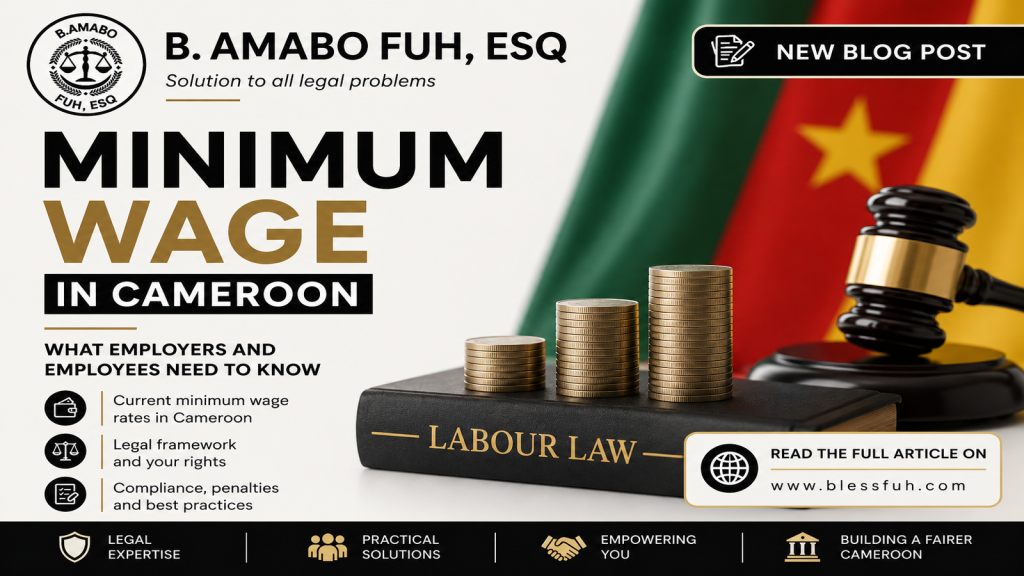
Minimum Wage in Cameroon: The Employer’s Guide to Staying Compliant
If you employ staff in Cameroon, the minimum wage in Cameroon isn’t a number you can guess at or carry over from an old spreadsheet. It’s a legal floor set by government decree, it has shifted twice in recent years, and paying below it — even unknowingly — puts your business squarely in the path of labour inspectors, back-pay claims, and reputational damage.
Getting this right isn’t just about compliance. It’s about running a business that investors, partners, and employees can trust.
Why the Minimum Wage in Cameroon Figure You’ve Seen Online May Be Wrong
Search “minimum wage in Cameroon” and you’ll find a confusing mix of numbers — 36,270 FCFA, 41,875 FCFA, 43,969 FCFA, 60,000 FCFA. Each of these was correct at some point. Most of them are now outdated, and using the wrong figure in your payroll planning can leave you underpaying staff without realizing it.
The core legal reference is the Guaranteed Interprofessional Minimum Wage(GMW) known in french as the SMIG — Salaire Minimum Interprofessionnel Garanti set out under Cameroon’s Labour Code and fixed by prime ministerial decree.1 Understanding how it evolved is the fastest way to know which figure actually applies to you today.
Why Getting The Guaranteed Minimum Wage in Cameroon Right Protects You From
- Labour inspection findings and the operational disruption that follows
- Civil claims from employees for unpaid wages, which can reach back several years
- Reputational and financing risk if partners or lenders review your compliance history
- The cost and disruption of correcting payroll retroactively across your workforce
How the SMIG Has Changed Since 2023
For nearly a decade, Cameroon’s SMIG sat at a flat 36,270 FCFA per month under a 2014 decree. That changed with Decree No. 2023/00338/PM, signed 21 March 2023, which introduced three separate tiers instead of one uniform figure:
- 41,875 FCFA/month — State agents governed by the Labour Code
- 45,000 FCFA/month — Agricultural and related-sector workers
- 60,000 FCFA/month — All other private-sector activities
Less than a year later, a further decree signed 23 February 2024 raised the state-agents tier specifically, from 41,875 FCFA to 43,969 FCFA — leaving the agricultural and general-sector figures untouched at their 2023 levels.
For most private employers, the operative floor today is 60,000 FCFA per month — not the older figures still circulating on outdated sites.
SMIG Cameroon: Sector by Sector
Not every business owner needs the same number, and this is where confusion causes the most compliance risk.
| Sector | Current SMIG |
| State agents under the Labour Code | 43,969 FCFA/month |
| Agricultural and related sectors | 45,000 FCFA/month |
| All other private-sector activities | 60,000 FCFA/month |
Beyond the SMIG floor, many industries operate under collective bargaining agreements that set higher sectoral minimums by role and seniority. Where a collective agreement applies to your industry, it overrides the baseline SMIG figure — and ignoring it is just as risky as ignoring the SMIG itself.
What Employers Should Do Before Their Next Payroll Cycle
- Confirm your sector’s applicable tier. Don’t assume — verify whether your workforce falls under the general, agricultural, or public-service category.
- Check for a governing collective agreement. If one exists for your industry, its minimums likely supersede the national SMIG.
- Build in a compliance margin. With two revisions in under twelve months and further government signals of another increase to come, treat today’s figure as a floor to build above, not a permanent ceiling.
- Document your basis for every pay grade. If a labour inspector visits, being able to show exactly how each salary was set — and against which legal reference — is your strongest protection.
Is Another Increase Coming?
At Labour Day events in 2026, Cameroon’s Minister of Labour and Social Security publicly signaled that the SMIG could be revised upward again, though he indicated the change would come “at a reasonable time” rather than immediately. Nothing has been formally enacted as of this writing, but employers budgeting for the year ahead should treat this as a live possibility, not a rumor to dismiss.
Frequently Asked Questions
What is the current minimum wage in Cameroon? It depends on your sector. Most private employers must pay at least 60,000 FCFA per month, while agricultural workers have a floor of 45,000 FCFA and state agents under the Labour Code sit at 43,969 FCFA.
Has the minimum wage in Cameroon increased recently? Yes. It rose from a flat 36,270 FCFA in 2023 to a three-tier structure, and the state-agents tier was raised again in 2024. Further increases have been signaled but not yet confirmed.
Does the minimum wage apply to informal-sector workers? Legally, yes — the SMIG applies regardless of sector. In practice, enforcement is far harder in the informal economy, which still represents the majority of Cameroon’s workforce.
Can a collective bargaining agreement set a higher minimum than the SMIG? Yes, and where one applies to your industry, it takes precedence over the baseline SMIG figure for covered employees.
What happens if I pay below the minimum wage in Cameroon? Employers risk labour inspection sanctions, employee claims for back pay covering several years, and potential reputational harm with partners and financing institutions.
How is the hourly minimum wage calculated in Cameroon? The hourly rate is typically derived from the monthly SMIG divided across the standard 173.33 monthly working hours for non-agricultural roles under a 40-hour week.
Don’t Let an Outdated Number Put Your Business at Risk
Minimum wage in Cameroon has changed twice in under two years, and another revision may be on the way. If you’re not certain your payroll reflects the correct figure for your sector, now is the time to check — before an inspection forces the issue.
Speak with B Amabo Fuh, Esq. today for a compliance review that protects your business, your employees, and your reputation. A short conversation now can save you significant exposure later.
This article is for general informational purposes and does not constitute legal advice. Confirm the applicable rate and any sector-specific collective agreements with counsel before finalizing payroll decisions.
- DECREE No 2023/00338/PM OF 21 MARCH 2023 to fix the Guaranteed Minimum Wage (GMW) and DECREE No 2024/0168/PM OF 23 FEBUARY 2024 to fix the Guaranteed Minimum Wage of State Employees Governed by the Labour Code
↩︎
Pingback: Labour Law in Cameroon: The Complete Employer & Employee Guide