
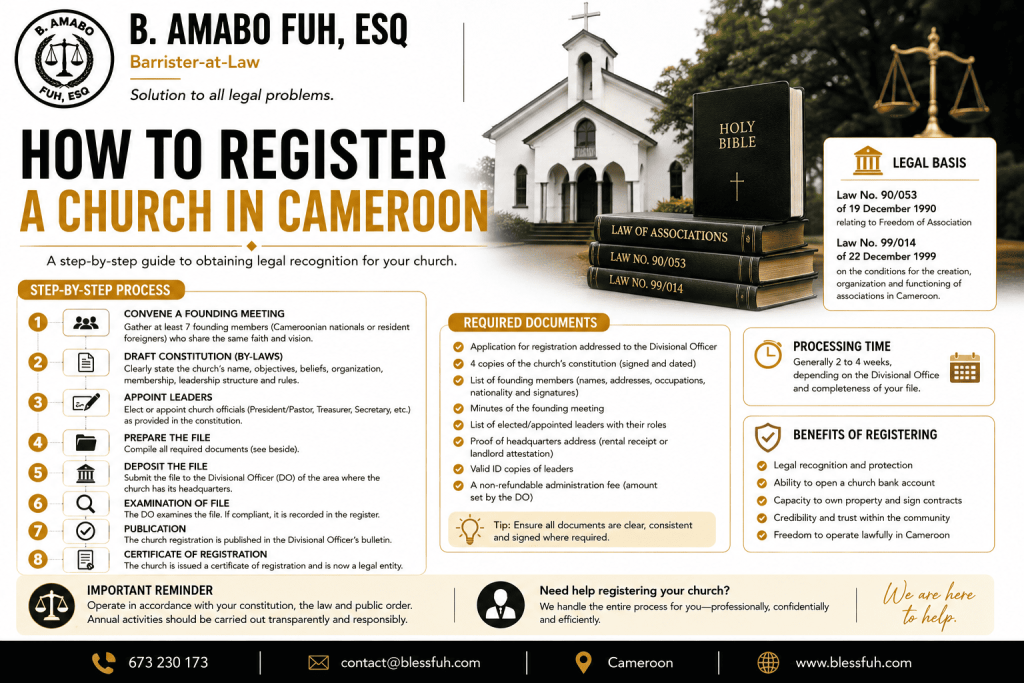
How to Register a Church in Cameroon: A Complete Legal Guide
If you are planning to establish a church, ministry, Christian fellowship or other religious organisation in Cameroon, there is an important legal point you need to understand from the beginning:
You do not register a church in Cameroon in exactly the same way as an ordinary association.
Religious organisations are subject to a specific authorisation regime under Cameroon’s law on freedom of association. In practice, a church seeking legal recognition must obtain authorisation as a religious association rather than simply declaring itself as an ordinary association.
This distinction is important because many people establish a church, rent premises, begin holding services and only later discover that operating a religious organisation involves a different legal process.
This guide explains how to register a church in Cameroon, the applicable law, the role of the Ministry of Territorial Administration (MINAT), the documents and legal structure you should prepare, and the difference between starting a church and obtaining legal authorisation.
Important: This article concerns the legal establishment and authorisation of a church or religious association in Cameroon. It should not be confused with registering an ordinary civil association or obtaining NGO status.
What Law Governs the Registration of a Church in Cameroon?
The principal legislation is Law No. 90/053 of 19 December 1990 relating to freedom of association, as subsequently amended.
The law distinguishes ordinary associations from certain organisations that are subject to an authorisation regime, including religious associations.
The Ministry of Territorial Administration’s own website confirms that its Division of Religious Affairs (Service des Cultes) is responsible for enforcing legislation relating to freedom of religion and the free exercise of worship, examining applications for the authorisation of religious associations, and maintaining the legal denominational register.
Therefore, when considering how to register a church in Cameroon, the correct legal question is not simply:
“Where do I declare my association?”
It is:
“How do I obtain authorisation for my religious association?”
Can You Simply Register a Church as an Association?
This is one of the biggest misconceptions surrounding church registration in Cameroon.
An ordinary association generally follows a declaration procedure.
A religious association, however, falls under a special authorisation regime.
The practical consequence is that you should not assume that filing an ordinary association declaration with the SDO’s Office automatically confers on a church the legal status required to operate as an authorised religious body.
Recent presidential decrees demonstrate this distinction.
For example, on 23 January 2026, the President of the Republic issued decrees authorising several religious bodies, including the Eglise Evangélique Libre du Cameroun, the Communauté Missionnaire Chrétienne Internationale, Winners Chapel International, and Reformed Overcomers Chapel. These decrees expressly cite Law No. 90/053 of 19 December 1990 as their legal basis.
This shows that church authorisation is not merely a private registration exercise.
How to Register a Church in Cameroon
The process should be approached carefully and in stages.
Step 1: Determine the Church’s Legal Identity
Before preparing the application, the founders should determine exactly what they are establishing.
For example, it could be:
- A Christian church;
- An evangelical church;
- A Pentecostal church;
- A missionary organisation;
- A ministry;
- A Christian fellowship; or
- Another religious body.
The organisation’s identity should be reflected consistently in its:
- Name;
- Statutes;
- Doctrinal statement;
- Objectives;
- Governance structure;
- Leadership;
- Activities; and
- Application for authorisation.
A church should not have one name in its constitution, another on its signboard and a third name in its application.
Consistency matters.
Step 2: Choose the Name of the Church
The founders should select an appropriate name for the religious organisation.
For example:
“New Covenant Christian Church of Cameroon.”
Before adopting the name, it is advisable to carry out appropriate checks to determine whether the name is already associated with another religious organisation or could create confusion.
The name should also accurately reflect the organisation’s identity and should not be framed in a manner that creates legal or public-order concerns.
Step 3: Define the Church’s Doctrine and Objectives
This is one area where registering a church differs significantly from registering an ordinary social association.
The church’s documentation should clearly explain:
- Its religious identity;
- Its beliefs or doctrinal foundation;
- Its mission;
- Its objectives;
- Its worship practices;
- Its organisational structure;
- Its religious activities; and
- The manner in which it intends to carry out those activities.
A vague objective such as:
“To preach the gospel and help people”
may be insufficient as the sole description of the organisation.
The founding documents should give the administration a clear understanding of the organisation being proposed.
Step 4: Draft the Church’s Statutes
The statutes are a critical part of the application.
They should establish the legal and administrative framework of the religious organisation.
Among other matters, properly drafted statutes should address:
Name
The official name of the church.
Headquarters
The principal headquarters of the organisation.
Objectives
The religious purposes and activities of the church.
Membership
Who may become a member and the rights and obligations of members.
Leadership
The persons and organs responsible for managing the church.
For example:
- General Assembly;
- Board of Elders;
- Board of Directors;
- General Overseer;
- President;
- Secretary General;
- Treasurer; and
- Other appropriate organs.
Appointment and Removal of Leaders
The statutes should explain how church leaders are appointed, replaced or removed.
Meetings
The procedure for convening and conducting meetings.
Financial Administration
The sources and management of church funds.
Property
Rules governing the acquisition, management and use of church property.
Discipline
Where appropriate, the procedures applicable to members and leaders.
Amendment
How the statutes can be amended.
Dissolution
What happens if the church is dissolved and how its assets are dealt with.
A church should not rely on a generic constitution copied from another organisation without adapting it to its own structure.
Step 5: Identify the Founders and Leadership
The church should have a clearly identifiable leadership structure.
The authorities need to know who is responsible for the proposed religious body.
The application should therefore be supported by appropriate information concerning the persons responsible for administering or directing the organisation.
This is particularly important where the church is being established by several founders.
The statutes should clearly distinguish between:
Founders → members → governing organs → religious leaders.
These categories do not necessarily have to be identical.
Step 6: Establish the Church’s Headquarters
The proposed church should have a clearly identified headquarters.
The headquarters should be reflected consistently in the:
- Statutes;
- Application;
- Administrative records; and
- Other supporting documents.
If the church later changes its headquarters, the appropriate administrative formalities should be followed.
The Ministry of Territorial Administration administers Cameroon through regional, departmental and sub-divisional structures, while the Ministry’s central services deal with matters within its statutory responsibilities.
Step 7: Prepare the Application for Authorisation
The next step is to prepare the application for authorisation as a religious association.
This is where legal assistance can be particularly valuable.
Rather than simply submitting a letter saying:
“I want to register my church”,
the application should form part of a coherent legal file.
The file should be prepared to demonstrate:
- The identity of the religious organisation;
- Its objectives;
- Its doctrinal basis;
- Its headquarters;
- Its leadership;
- Its governance structure;
- Its statutes;
- Its proposed activities; and
- Other information required by the competent administration.
Because administrative requirements and documentary practices can change, applicants should verify the current filing checklist with the competent services before submission.
Step 8: Submit the Application Through the Appropriate Administrative Channel
Unlike an ordinary association, where the declaration procedure is principally handled at the SDO’s Office, a church seeking legal authorisation falls within the regulatory framework for religious associations.
The Ministry of Territorial Administration has a dedicated Division of Religious Affairs (Service des Cultes) responsible for examining applications for authorisation of religious associations.
This is why it is important to identify the correct administrative route before submitting the application.
A common mistake is to submit the wrong type of application to the wrong authority and assume that the filing itself creates legal status.
It does not.
Step 9: Administrative Examination of the Application
The application is examined by the competent administrative authorities.
The administration may consider matters relating to the organisation’s:
- Identity;
- Objectives;
- Leadership;
- Statutes;
- Activities;
- Headquarters;
- Religious character; and
- Compliance with applicable law.
The applicant should therefore ensure that the information contained throughout the file is accurate and consistent.
Contradictions between the statutes, application, leadership documents and other supporting documents can create unnecessary difficulties.
Step 10: Obtain the Authorisation
The final authorisation of religious associations is made through a presidential decree.
This is not merely theoretical.
Recent official decrees demonstrate that religious bodies are authorised by presidential decree under Law No. 90/053.
For example, Decree No. 2026/021 of 23 January 2026 authorised the Eglise Evangélique Libre du Cameroun, headquartered in Yaoundé.
Similarly, Decree No. 2026/022 of 23 January 2026 authorised Winners Chapel International, headquartered in Douala.
And Decree No. 2026/018 of 23 January 2026 authorised Reformed Overcomers Chapel, headquartered in Bamenda.
These examples are useful because they demonstrate the actual legal form through which religious associations are authorised in Cameroon.
Is Church Registration the Same as NGO Registration?
No.
This distinction is extremely important.
A church is a religious association.
An NGO is an organisation governed by a separate legal framework, principally Law No. 99/014 of 22 December 1999.
Although a church may carry out humanitarian, educational or social activities, that does not automatically transform it into an NGO.
Similarly, registering an NGO does not automatically authorise it to operate as a church.
The legal status should correspond with the organisation’s actual purpose.
Is Church Registration the Same as Registering an Ordinary Association?
Again, no.
An ordinary association generally operates under the declaration regime established by Law No. 90/053.
Religious associations fall under the special authorisation framework.
The Ministry of Territorial Administration expressly identifies the examination of applications for authorisation of religious associations as a function of its Service des Cultes.
Therefore:
Ordinary association → declaration regime
Religious association/church → authorisation regime
That distinction should guide the entire registration strategy.
Can a Pastor Simply Start a Church Without Authorisation?
The fact that a person can privately hold religious beliefs or worship does not mean that they have automatically obtained legal recognition for a formal religious association.
A church that intends to operate as a legally recognised religious body should comply with the applicable authorisation regime.
This is particularly important when the organisation intends to:
- Operate formally under a church name;
- Acquire or manage property;
- Open institutional bank accounts;
- Employ personnel;
- Enter contracts;
- Conduct large-scale activities;
- Establish branches;
- Receive significant donations; or
- Present itself publicly as a legally recognised religious organisation.
The safest approach is to determine the legal status required before building a substantial institutional structure around the church.
Can a Church Buy Land in Cameroon?
A church may need property for:
- Worship;
- Offices;
- Schools;
- Training centres;
- Accommodation;
- Community programmes; or
- Other legitimate activities.
However, acquiring land in the name of a church should not be approached casually.
Before purchasing property, the church should ensure that:
- The legal status of the organisation is properly established;
- The seller has valid title or rights over the property;
- The transaction is properly documented;
- The land is appropriately verified;
- The acquisition complies with applicable land and registration laws; and
- The person signing the transaction has the necessary authority.
This is particularly important because land disputes are common and the fact that a property is intended for religious use does not eliminate the need for proper land due diligence.
Can a Church Collect Donations?
Churches commonly depend on:
- Offerings;
- Tithes;
- Donations;
- Contributions;
- Grants; and
- Other lawful sources of funding.
However, public fundraising can be subject to separate regulatory requirements.
For example, MINAT has published orders authorising appeals for public donations under the legislation governing public donations. One such order authorised a public appeal for donations by the Conseil Supérieur Islamique du Cameroun for a specified period.
Therefore, a church should not assume that every form of public fundraising is automatically unrestricted merely because the organisation is religious.
The nature and scale of the fundraising activity should be examined before proceeding.
What Documents Should a Church Prepare?
While the exact administrative checklist should be confirmed with the competent authority, a church preparing an application should generally expect to work on documents such as:
- Application for authorisation;
- Proposed statutes;
- Minutes of the constitutive meeting;
- List of founders;
- Information concerning the leaders;
- Identification documents where required;
- Statement of the church’s objectives;
- Doctrinal statement;
- Address and evidence relating to the headquarters;
- Programme or description of proposed activities; and
- Other supporting documents requested by the administration.
The precise requirements should be verified at the time of filing.
This is particularly important because an incomplete or poorly structured file can cause delays.
How Long Does It Take to Register a Church in Cameroon?
This is one of the questions for which it is dangerous to give applicants an artificial number of days.
Unlike an ordinary association, which has a statutory declaration mechanism, religious associations are subject to an authorisation process.
The final authorisation is made by presidential decree.
Recent decrees show that the process remains active, with several religious organisations receiving presidential authorisation in January 2026.
However, the existence of a statutory framework does not mean that every application will be approved within a guaranteed number of days.
Applicants should therefore plan for an administrative process rather than promising themselves a fixed registration deadline.
Common Mistakes When Registering a Church in Cameroon
1. Treating the church as an ordinary association
This is probably the most common mistake.
A church is subject to the special regime applicable to religious associations.
2. Starting operations before understanding the legal status
Do not build a large institution first and only investigate legal recognition later.
3. Using generic statutes
Church statutes should reflect the actual governance structure of the organisation.
4. Failing to define the church’s doctrine and objectives
The administration should be able to understand precisely what the organisation represents and intends to do.
5. Using inconsistent information
The church’s name, headquarters and leadership should be consistent across the application and supporting documents.
6. Ignoring financial governance
Churches handle money.
There should therefore be proper controls over:
- Offerings;
- Donations;
- Bank accounts;
- Expenditure;
- Property;
- Salaries; and
- Other financial resources.
7. Assuming authorisation covers every future activity
Church authorisation does not mean that every activity the church might later undertake is automatically exempt from other regulatory requirements.
For example, schools, hospitals, public fundraising campaigns, construction projects, employment and land transactions can each trigger additional legal requirements.
How to Register a Church in Cameroon: Practical Checklist
Before submitting an application, the founders should consider whether they have:
- Chosen a legally appropriate name;
- Clearly defined the church’s mission;
- Prepared a doctrinal statement;
- Defined the church’s objectives;
- Identified the founders;
- Established the leadership structure;
- Identified the headquarters;
- Drafted comprehensive statutes;
- Held the constitutive meeting;
- Prepared the minutes of the meeting;
- Prepared the application for authorisation;
- Prepared the supporting documents;
- Verified the appropriate administrative procedure;
- Submitted the application through the competent authority; and
- Kept copies and proof of all documents submitted.
Final Thoughts: How to Register a Church in Cameroon
If you are researching how to register a church in Cameroon, the most important point to remember is this:
A church is not simply an ordinary association with a religious name.
Religious associations are subject to a special authorisation regime under Cameroon’s legislation on freedom of association. MINAT’s Service des Cultes is specifically responsible for examining applications for authorisation of religious associations.
The process can therefore be broadly understood as:
Define the church → choose the name → prepare the doctrine and objectives → draft the statutes → establish the leadership → prepare the application → submit through the appropriate administrative process → administrative examination → presidential authorisation.
Recent presidential decrees, including those issued in January 2026, confirm that religious bodies continue to receive legal authorisation through presidential decree.
The lesson for founders is simple:
Do not treat church registration as paperwork to be completed after the church has already been established. Legal structuring should come first.
If you are planning to establish a church in Cameroon, B. AMABO FUH, ESQ. can assist with the preparation and legal structuring of the church’s founding documents, statutes and application for authorisation.
For professional legal assistance, visit www.blessfuh.com.
This article on How to register an Church in Cameroon should not be taken as legal advice; it is intended as a general guide for informational purposes only. Specialist advice should be sought
Contact B Amabo FUH, ESQ today to schedule a confidential consultation and receive experienced legal guidance for your next real estate transaction or property dispute.
What law governs church registration in Cameroon?
Churches and other religious associations are principally governed by Law No. 90/053 of 19 December 1990 relating to freedom of association, as amended. Religious associations are subject to a special authorisation regime rather than the ordinary declaration procedure.
Where do I register a church in Cameroon?
A church seeking legal recognition as a religious association should follow the authorisation process administered within the framework of the Ministry of Territorial Administration. MINAT’s Division of Religious Affairs (Service des Cultes) specifically handles applications for authorisation of religious associations.
Who authorises a church in Cameroon?
The legal authorisation of religious bodies is granted by presidential decree. Recent decrees from January 2026 demonstrate this procedure in practice.
Can I register my church as an ordinary association?
A church should not simply be treated as an ordinary declared association. Religious associations are subject to a specific authorisation regime under the applicable legislation.
How long does it take to register a church in Cameroon?
There is no responsible basis for promising every applicant a fixed processing period. Church registration involves an authorisation process culminating in presidential decree, and processing time may depend on the circumstances of the application and administrative process.
Can a foreign church operate in Cameroon?
A foreign religious organisation should not assume that authorisation granted in another country automatically permits it to operate as a religious association in Cameroon. The organisation’s structure, status and activities should be examined under Cameroonian law before commencing operations.
Is a church the same as an NGO?
No. A church is a religious association, while an NGO is governed by a separate legal framework. The two statuses should not be confused.