How to Register an Association in Cameroon: A Complete Legal Guide
If you are planning to establish a community organisation, charity, professional group, youth organisation, development initiative, social club or other non-profit body in Cameroon, one of the first questions you will probably ask is: how to register an association in Cameroon?
The good news is that the legal framework for ordinary associations is relatively straightforward.
Unlike a company, an association is not created to distribute profits among its members. Under Cameroonian law, an association is an agreement by which persons pool their knowledge or activities for a purpose other than sharing profits.
The principal legislation is Law No. 90/053 of 19 December 1990 relating to freedom of association, as amended, including by Law No. 2021/022 of 16 December 2021.
This article explains how to register an association in Cameroon, the documents you need, where to file them, how long the process takes, what should be contained in the statutes, and some of the mistakes founders should avoid.
What Is an Association Under Cameroonian Law?
Article 2 of Law No. 90/053 defines an association as a convention by which persons put together their knowledge or activities for a purpose other than sharing profits.
In simple terms, an association allows people to come together around a common non-profit objective.
That objective could include:
- Community development;
- Education;
- Youth empowerment;
- Social welfare;
- Environmental protection;
- Professional development;
- Cultural activities;
- Sports;
- Humanitarian activities;
- Religious activities, subject to the applicable special regime;
- Advocacy; or
- Other lawful non-profit purposes.
However, not every organisation falls under exactly the same registration regime.
The 2021 amendment to Law No. 90/053 expressly provides that political parties, trade unions, sports associations, NGOs, artistic and cultural associations and interprofessional organisations are governed by specific legislation.
That distinction is important.
If you are creating an ordinary civil association, the declaration procedure under Law No. 90/053 is generally the relevant starting point.
If you are establishing an NGO, religious association, sports association, artistic and cultural association or another specially regulated organisation, additional legislation may apply.
How to Register an Association in Cameroon
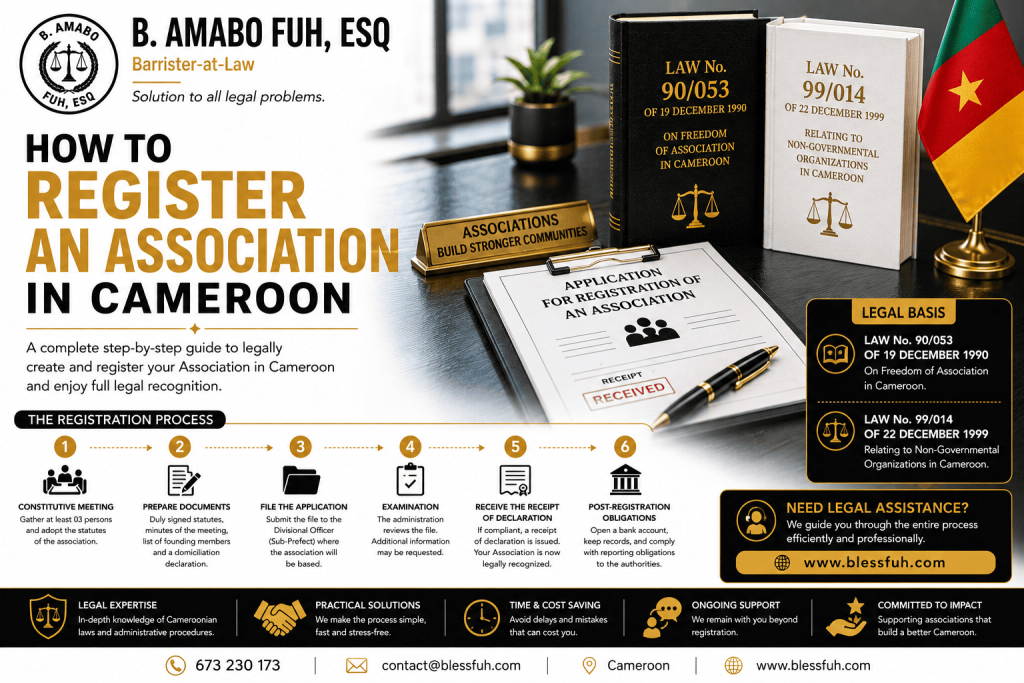
For an ordinary association, the process can be broken down into several practical steps.
Step 1: Determine the Purpose of the Association
Before preparing any documents, the founders should clearly determine what the association is being created to accomplish.
This should be more than a general statement such as:
“To help the community.”
A properly defined objective should identify what the association intends to do and whom or what interests it intends to serve.
For example:
“To promote access to educational opportunities for disadvantaged young people in the South-West Region of Cameroon.”
The purpose of the association is important because it will appear in the statutes and declaration documents.
It also helps determine whether the organisation falls under the ordinary association regime or a special legal framework.
Step 2: Choose the Name of the Association
The founders should choose a name that properly identifies the organisation.
The proposed name should not be unlawful, misleading or contrary to public order.
It is also advisable to conduct appropriate checks before adopting the name, particularly where the association will have a public-facing identity, website, social media presence or branded activities.
Do not assume that because a name is available on social media, it is automatically legally available.
Step 3: Draft the Statutes
The statutes are arguably the most important document when you register an association in Cameroon.
They establish the legal and organisational framework within which the association will operate.
The statutes should ordinarily address matters such as:
1. Name
The official name of the association.
2. Purpose
The objectives and activities of the organisation.
3. Headquarters
The registered headquarters of the association.
4. Membership
The conditions for becoming a member, rights and obligations of members, resignation and termination of membership.
5. Governance
The organs responsible for managing the association.
For example:
- General Assembly;
- Executive Committee;
- President;
- Secretary General;
- Treasurer; and
- Other officers appropriate to the organisation.
6. Decision-making
The statutes should establish how meetings are convened, how decisions are taken, quorum requirements and voting procedures.
7. Finances
The statutes should address sources of funding, membership contributions, management of funds and financial accountability.
8. Amendment of the Statutes
The procedure for changing the constitution of the association.
9. Dissolution
The circumstances and procedure for dissolving the association and dealing with its assets.
A common mistake is to download a generic constitution from the internet and simply replace the name.
That can create problems later.
Your statutes should reflect how your association will actually operate.
Step 4: Hold the Constitutive General Meeting
Once the founders have agreed on the organisation’s purpose and statutes, they should hold the meeting at which the association is formally constituted.
The founders should adopt the statutes and establish the management structure of the organisation.
Minutes should be prepared to document the decisions taken.
Depending on the structure adopted, the meeting may also determine the persons responsible for administering or directing the association.
This is important because the declaration to the administration must identify the persons responsible for the association’s administration or management.
Step 5: Prepare the Declaration File
This is the central stage when you register an association in Cameroon.
Under Article 6 of Law No. 90/053, associations are freely created but acquire legal personality only after making the required declaration accompanied by two copies of their statutes.
Article 7 further provides that the declaration must contain:
- The name/title of the association;
- Its purpose;
- Its headquarters;
- The names of the persons responsible for its administration or direction;
- Their professions; and
- Their domiciles.
The precise administrative checklist may vary according to the competent office and the nature of the association, so it is sensible to verify the current filing requirements before submitting the application.
Step 6: File the Declaration at the SDO
For an ordinary association, the declaration is made by the founders at the Senior Divisional Officer’s office of the division where the association has its headquarters.
Article 7 of Law No. 90/053 expressly provides for the declaration to be made at the Prefecture of the department where the association’s headquarters are located.
For example, if an association has its headquarters in Buea, the appropriate divisional administrative authority is determined by the location of that headquarters, which is the SDO located in Limbe.
The declaration should be submitted with the required documents.
When the file is complete and the association is not subject to one of the statutory grounds of nullity, a receipt is issued.
Always keep a copy of everything submitted and the receipt acknowledging the filing.
Step 7: Understand the Two-Month Rule
One of the most important provisions to understand when asking how to register an association in Cameroon is Article 7(3) of Law No. 90/053.
The law provides that where the SDO remains silent for two months after the declaration has been filed, that silence constitutes acceptance and results in the acquisition of legal personality.
This means that the process should not be understood as requiring a discretionary “approval” in the same way as certain specially regulated organisations.
For an ordinary declared association, the law establishes a declaration regime.
That is a fundamental distinction between ordinary associations and organisations subject to an authorisation regime.
How Long Does It Take to Register an Association in Cameroon?
The statutory framework provides a two-month period following the filing of the declaration.
If the SDO remains silent for two months after the declaration, the law provides that the silence constitutes acceptance and the association acquires legal personality.
However, this should not be confused with saying that every administrative filing will physically take two months.
If the file is complete, the administration may issue a receipt upon filing.
The two-month provision is particularly important because it establishes the legal consequence of administrative silence.
What Documents Are Needed to Register an Association in Cameroon?
For an ordinary association, the core statutory requirements include:
- The declaration;
- Two copies of the association’s statutes;
- Information identifying the association;
- Its purpose;
- Its headquarters; and
- Information identifying the persons responsible for its administration or direction, including their professions and domiciles.
In practice, the administration may request additional supporting documents depending on the circumstances.
It is therefore advisable to prepare a complete administrative file rather than submitting only the bare statutory minimum.
A well-prepared file should normally include copies of the key constitutive documents and evidence of the identity and authority of the persons making the declaration.
Who Can Create an Association in Cameroon?
The law recognises freedom of association as the freedom to create, join or refuse to join an association.
It also states that this freedom is recognised to natural and legal persons throughout the national territory.
However, there are statutory restrictions.
Article 4 of Law No. 90/053 excludes associations founded for causes or purposes contrary to the Constitution, laws or public morality, as well as certain organisations whose purposes threaten public order or other legally protected interests.
Therefore, the fact that the law recognises freedom of association does not mean that every proposed association will be lawful.
Association Registration vs NGO Registration in Cameroon
This distinction deserves special attention.
Many people use the words association and NGO interchangeably.
Legally, that can be misleading.
An ordinary association generally falls under the declaration regime established by Law No. 90/053.
A Non-Governmental Organisation ( NGO), on the other hand, are specifically identified as organisations governed by particular legislation. The 2021 amendment to Law No. 90/053 confirms that NGOs are subject to special legislation.
In practical terms:
Association → declaration under the applicable association law.
NGO → special legal regime and approval requirements.
Therefore, if your long-term objective is to establish an NGO, you should structure the organisation from the beginning with that objective in mind.
From Association to NGO: The Natural Next Step
Many associations particularly those working on humanitarian, development, or advocacy projects eventually seek NGO status to unlock the ability to receive international funding, gifts, and legacies. Cameroonian practice requires an association to operate and build a track record for a qualifying period (commonly around three years) before applying for NGO recognition through the SDO and the Ministry of Territorial Administration. If that’s on your roadmap, it’s worth structuring your statutes, recordkeeping, and governance with that eventual transition in mind from day one.
Suspension and Dissolution of Association in Cameroon
An association can be dissolved voluntarily by its members in accordance with its statutes, or by court order where grounds for nullity exist. The Minister of Territorial Administration also has the power to:
- Suspend an association’s activities for up to three months, on the SDO’s reasoned recommendation, if it disturbs public order
- Dissolve an association whose activities have strayed from its stated purpose and seriously threaten public order or state security
These decisions can be challenged before the administrative courts within ten days of notification, though the appeal itself does not suspend the decision.
Are Religious Associations Registered the Same Way?
Not necessarily.
Law No. 90/053 distinguishes between ordinary declared associations and associations subject to an authorisation regime.
Religious and foreign associations fall within the authorisation category rather than the ordinary declaration regime.
Therefore, someone planning to establish a religious organisation should not simply follow the ordinary association declaration procedure without first determining the specific legal regime applicable to the organisation.
What Happens After an Association Is Registered?
Registration is not the end of the legal obligations.
Once the association has legal personality, it should operate according to:
- Its statutes;
- Applicable Cameroonian legislation;
- Decisions of its competent organs; and
- Its stated objectives.
The law provides that associations administer themselves freely in accordance with their statutes and legislation in force.
The association should therefore maintain proper governance and records.
These may include:
- Minutes of General Assembly meetings;
- Membership records;
- Financial records;
- Annual activity reports;
- Executive decisions;
- Bank records;
- Contracts;
- Receipts and supporting documents; and
- Records of changes in the organisation’s administration.
What If the Association Changes Its Address or Leaders?
The law does not treat the information contained in the original declaration as permanently fixed.
Article 7 requires changes to the association’s title, purpose, headquarters, and the persons responsible for its administration or direction to be notified to the SDO within two months.
This is an obligation that is frequently overlooked.
For example, if an association changes its headquarters or replaces its principal officers, the organisation should not simply update its internal records and leave the administration’s records unchanged.
The relevant change should be formally notified.
Can an Association Make Money in Cameroon?
An association is not established for the purpose of distributing profits among its members.
That does not mean that an association can never receive money.
An association may have legitimate sources of funds to support its activities, such as:
- Membership contributions;
- Donations;
- Grants;
- Sponsorship;
- Fundraising activities; and
- Other lawful sources consistent with its objectives and applicable legislation.
The critical distinction is between raising and using funds to pursue the association’s lawful objectives and distributing profits to members as if the organisation were a commercial company.
Common Mistakes When Registering an Association in Cameroon
1. Treating an association like a company
An association and a company serve different legal purposes.
Do not simply copy company incorporation documents and replace “company” with “association.”
2. Using vague objectives
Your objectives should clearly explain what the organisation intends to accomplish.
3. Poorly drafted statutes
The constitution should anticipate real governance issues rather than merely satisfy the filing requirement.
4. Failing to keep the declaration receipt
The receipt is important evidence of the filing.
Keep it safely.
5. Failing to report changes
Changes to the association’s name, purpose, headquarters or management must be communicated within the period prescribed by law.
6. Assuming every organisation follows the same procedure
NGOs, religious organisations, foreign associations, sports associations, artistic and cultural associations and other specially regulated organisations may be governed by different legal regimes.
7. Registering without considering the long-term objective
If the founders ultimately want NGO status, public-interest recognition or another regulated status, that objective should be considered from the beginning.
Association Registration in Cameroon: The Practical Checklist
Before filing your declaration, make sure you have:
- A clear and lawful name;
- Clearly defined objectives;
- A headquarters in Cameroon;
- Properly drafted statutes;
- Identified the persons responsible for administration or direction;
- Held the constitutive meeting;
- Prepared the minutes of the meeting;
- Prepared the declaration;
- Prepared two copies of the statutes;
- Confirmed the competent Prefecture;
- Submitted the declaration;
- Obtained and preserved the filing receipt; and
- Made any subsequent changes known to the administration within the prescribed period.
Final Thoughts: How to Register an Association in Cameroon
The process to register an association in Cameroon is based principally on a declaration system under Law No. 90/053 of 19 December 1990, as amended.
The basic process is:
Define the purpose → choose the name → draft the statutes → constitute the association → prepare the declaration → file at the competent SDO → obtain the receipt → comply with the statutory requirements and subsequent reporting obligations.
The law provides that an ordinary association acquires legal personality through the prescribed declaration procedure, with administrative silence for two months constituting acceptance under Article 7.
But the most important lesson is this:
Do not begin with the paperwork. Begin with the legal structure.
A properly structured association with clear objectives, carefully drafted statutes, and sound governance arrangements will be far easier to operate than an organisation created simply because someone found a template online.
If you are planning to register an association in Cameroon, B. AMABO FUH, ESQ. can assist with the preparation of the constitutive documents, drafting of statutes, declaration process and legal structuring of the organisation.
For legal assistance, visit www.blessfuh.com.
This article on How to register an Association in Cameroon should not be taken as legal advice; it is intended as a general guide for informational purposes only. Specialist advice should be sought
Contact B Amabo FUH, ESQ today to schedule a confidential consultation and receive experienced legal guidance for your next real estate transaction or property dispute.
What law governs association registration in Cameroon?
The principal legislation is Law No. 90/053 of 19 December 1990 relating to freedom of association, as amended. Law No. 2021/022 of 16 December 2021 subsequently amended certain provisions of the 1990 law.
Where do I register an association in Cameroon?
For an ordinary declared association, the declaration is made at the Prefecture of the department where the association has its headquarters.
How long does it take to register an association in Cameroon?
The law provides that if the Prefect remains silent for two months after the filing of the declaration, that silence constitutes acceptance and the association acquires legal personality.
How many copies of the statutes are required?
Article 6 of Law No. 90/053 requires the declaration to be accompanied by two copies of the statutes.
Is an NGO the same as an association?
Not necessarily. NGOs are subject to a specific legal regime. The 2021 amendment to Law No. 90/053 expressly states that NGOs and certain other categories of organisations are governed by particular legislation.
Do I need a lawyer to register an association in Cameroon?
The law does not make the use of a lawyer a universal prerequisite for declaring an ordinary association. However, professional legal assistance can be valuable when drafting statutes, structuring governance, determining the correct legal regime and preparing the administrative file.
Pingback: How to Register an NGO in Cameroon: Complete Legal Guide
Pingback: How to Register a Church in Cameroon: Legal Requirements & Process