How to Register an NGO in Cameroon: A Complete Legal Guide
Every year, individuals and groups across Cameroon set out to formalize community, humanitarian, or development projects — and quickly discover that “starting an NGO” is not a single-step process. If you want to register an NGO in Cameroon, the law requires you to pass through an intermediate stage first: you must legalize your group as an association, operate it for a minimum period of 3 years, and only then apply for recognition as a Non-Governmental Organization (NGO).
If you are planning to start a humanitarian, educational, environmental, social, health, human-rights or development organisation in Cameroon, one of the first questions you are likely to ask is: how do you register an NGO in Cameroon?
The answer is not as simple as filling out a registration form and collecting an NGO certificate.
Cameroon’s legal framework makes an important distinction between an association and a Non Governmental Organization (NGO). An association may first be declared under the law on freedom of association, while NGO status requires a separate approval procedure under the law specifically regulating NGOs.
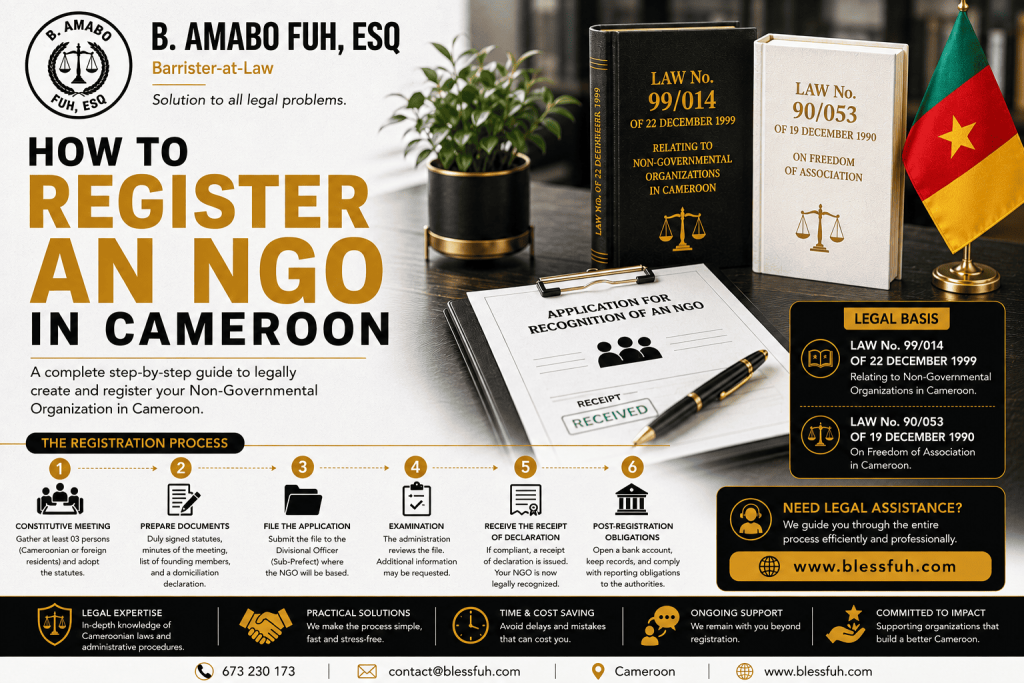
The principal legislation is Law No. 99/014 of 22 December 1999 regulating Non-Governmental Organisations, read alongside the legislation on freedom of association, including Law No. 90/053 of 19 December 1990 and its subsequent amendments.
This guide explains how to register an NGO in Cameroon, the documents required, where the application is filed, how long the process can take, and some of the mistakes founders should avoid.
What Is an NGO in Cameroon?
Under Law No. 99/014, an NGO is essentially an association that has been duly declared, or a foreign association that has been duly authorised, and which has subsequently been approved by the administration to participate in carrying out missions of general interest.
The law identifies areas such as legal, economic, social, cultural, health, sporting, educational and humanitarian activities, environmental protection and the promotion of human rights as areas of general interest.
This distinction is important.
Registering an association is not automatically the same thing as obtaining NGO status.
That is one of the most common misconceptions about NGO registration in Cameroon.
Local NGOs vs. International NGOs
Cameroonian law distinguishes between a local NGO of Cameroonian origin and an international NGO seeking to operate within Cameroon. International NGOs face an additional layer of formalities, generally involving a cooperation or establishment agreement with the Cameroonian government, since they are extending an already-existing foreign entity into national territory rather than forming a new domestic association from scratch. If you’re setting up a branch of a foreign NGO, it’s worth getting tailored legal advice early, as the documentation and ministerial channels differ from the local pathway described above.
The Laws Governing NGO Registration in Cameroon
The principal legal texts you should know are:
1. Law No. 90/053 of 19 December 1990
This is the principal legislation governing freedom of association in Cameroon.
For ordinary associations, the law provides for a declaration at the Divisional Office of the division where the association has its headquarters. The declaration is accompanied by two copies of the statutes.
The law also provides that, where the required conditions are met, silence by the Prefect for two months following the declaration amounts to acceptance and acquisition of legal personality.
2. Law No. 99/014 of 22 December 1999
This is the specific legislation regulating NGOs in Cameroon.
It establishes the procedure for obtaining approval as an NGO, the documents required, the technical commission responsible for examining applications, the powers of the Minister responsible for Territorial Administration and the obligations applicable to approved NGOs.
3. Law No. 2021/022 of 16 December 2021
This law amended Law No. 90/053 and expressly provides that NGOs, among other categories of organisations, are governed by specific legislation. This reinforces the point that NGO status is subject to its own legal framework rather than simply the ordinary association declaration procedure.
How to Register an NGO in Cameroon
The process should be approached in stages.
Step 1: Define the Purpose and Activities of the NGO
Before preparing any documents, the founders should clearly determine what the organisation intends to accomplish.
For example, an NGO could focus on:
- Education;
- Public health;
- Humanitarian assistance;
- Environmental protection;
- Women’s empowerment;
- Youth development;
- Human rights;
- Social development;
- Community development;
- Legal assistance; or
- Other activities falling within the recognised areas of general interest.
Your objectives should be properly reflected in the statutes and programme of activities.
A poorly drafted object clause can create problems later, particularly where the proposed activities do not correspond with the organisation’s stated mission.
Step 2: Choose the Appropriate Legal Structure
This is where many prospective NGO founders make their first mistake.
If you are establishing a conventional Cameroonian NGO, you will generally begin with an association.
Under Law No. 99/014, an association that has been regularly declared and has demonstrated at least three years of effective contribution in one of the areas of general interest listed by the law may apply for approval as an NGO.
In other words, an organisation does not ordinarily become an NGO merely because its founders have written “NGO” in its name.
There is a legal process for obtaining that status.
Step 3: Declare the Association
For an ordinary association, the declaration is made at the Divisional Officer’s Office of the division where the association has its headquarters.
The declaration must contain information including:
- The name of the association;
- A clear statement of the association’s purpose and objectives
- The proposed headquarters/location of the association
- The names and addresses of the founding members
- Their professions; and
- Their domiciles.
Two copies of the statutes accompany the declaration.
The administration issues a receipt where the file is complete.
This declaration gives the association its legal personality subject to the applicable legal requirements.
Before you can register an NGO in Cameroon, your organization must exist as a legally declared association. This is not optional, it is the mandatory first stage of the process, and there’s no way to skip directly to NGO status.
Core documents to compile:
- A handwritten (or typed and duly signed) application for legalization, addressed to the Senior Divisional Officer (SDO) through the Divisional Officer (DO) of the locality where the head office will be based
- The constitution (bylaws) of the association, conforming to the requirements of Law No. 90/053
- Minutes of the constitutive meeting at which the decision to form the association was taken, together with an attendance sheet
- The list of executive committee (exco) members, with their signatures
- Certified copies of the national identity cards of members
- A localisation plan showing the site of the association’s headquarters
The filing process:
The complete file is deposited at the Divisional Office (DO) for a first review, before being transmitted to the SDO’s office for approval. This can be handled personally by a delegated member of the association or by a solicitor acting on the association’s behalf. Once approval is granted, typically within a few months, the association can open a bank account in its own name, which allows it to legally begin receiving donations and support from sponsors and well-wishers.
Step 4: Operate the Association and Build a Three-Year Track Record
This is the step most first-time founders overlook. Under Cameroonian Law, an association generally needs to operate and demonstrate its activities for a period, commonly cited as around three years before it becomes eligible to apply for recognition as an NGO. During this window, it’s worth keeping meticulous records: annual activity reports, financial statements, project outcomes, and evidence of community impact, since these will strengthen the eventual NGO application.
This is one of the most important points for anyone asking how to register an NGO in Cameroon.
For an association seeking NGO approval under Article 4 of Law No. 99/014, the association must demonstrate at least three years of effective contribution in one of the fields recognised by the law.
The application therefore includes an evaluation report covering at least three years of activities.
This means that founders who want NGO status should not simply register an association and leave it dormant.
The organisation should actually conduct activities consistent with its stated objectives and maintain proper records of those activities.
Keep evidence such as:
- Activity reports;
- Financial records;
- Minutes of meetings;
- Project documents;
- Beneficiary records;
- Photographs and other evidence of activities;
- Funding records;
- Receipts and expenditure records; and
- Annual programmes.
These records can become important when demonstrating the organisation’s contribution over the required period.
Step 5: Prepare the NGO Accreditation File
After satisfying the applicable requirements, the organisation can prepare its application for NGO approval.
Under Article 4 of Law No. 99/014, the application file includes, among other things:
- A stamped application;
- A copy of the association’s declaration receipt or the relevant authorisation;
- An evaluation report covering at least three years of activities;
- The programme of activities;
- The minutes of the extraordinary general meeting serving as the constitutive meeting of the NGO;
- Four copies of the NGO’s statutes; and
- Information concerning the NGO’s name, purpose, headquarters and the persons responsible for its administration or management, including their professions and domiciles.
The quality of the documentation matters.
The objective is not merely to have a file containing the required pieces. The documents should tell a coherent story about the organisation, its activities, governance and public-interest mission.
Step 6: Submit the Application
The application for NGO approval is submitted by the founder(s) or their authorised representative to the services of the Governor of the Region where the NGO has its headquarters or principal establishment in Cameroon.
The application file typically includes:
- A formal application/motivation letter
- The updated constitution of the association
- Minutes and records evidencing the association’s activities over the qualifying period
- Passport-size photographs and identification of the trustees
- Details of the Board of Trustees who will govern the NGO
- Any supporting evidence of the association’s work and impact to date
A receipt acknowledging the filing, including the registration number and date, should be issued to the applicant.
Because NGOs are managed by a Board of Trustees rather than a simple executive committee, you’ll also need to confirm that each proposed trustee meets the legal eligibility requirements generally, being of legal age, of sound mind, not an undischarged bankrupt, and free of disqualifying criminal convictions.
The Governor has a maximum period of 15 days from the filing of the application to transmit it to the Technical Commission responsible for examining NGO accreditation applications to the Ministry of Territorial Administration (MINAT), which has final authority to grant NGO status.
Step 7: Examination by the Technical Commission
The application is then examined by the Technical Commission responsible for studying applications for NGO approval and monitoring NGO activities.
The Commission is composed of representatives of public authorities and civil society, and its statutory role includes examining applications and providing an opinion on matters relating to NGO approval and monitoring.
The Commission has a maximum period of 30 days from receipt of the application to transmit the file, together with a reasoned opinion, to the Minister responsible for Territorial Administration.
Step 8: Approval by the Minister Responsible for Territorial Administration
The final approval is granted by order of the Minister responsible for Territorial Administration, following the opinion of the Technical Commission.
Under Article 9 of Law No. 99/014, the Minister has a maximum period of 75 days from the date the application is filed with the Governor to make a decision.
If that period expires without the Minister notifying the applicant of a rejection and the reasons for the rejection, the approval is deemed granted under the law.
Approval results in the acquisition of legal personality by the NGO.
How Long Does NGO Registration Take in Cameroon?
The answer depends on which stage you are talking about.
There is a significant distinction between:
Registering an association and obtaining NGO status.
For an ordinary association, the declaration procedure is comparatively straightforward, with the law providing a two-month period after filing, after which silence by the Senior Divisional Officer constitutes acceptance in the circumstances provided by the law.
For NGO approval, however, the law itself contemplates a much longer process.
The Governor has up to 15 days to transmit the file to the Technical Commission, while the Commission has up to 30 days to transmit the file with its opinion to the Minister. The Minister has up to 75 days from the filing with the Governor to decide.
More importantly, an ordinary association seeking NGO status generally needs to demonstrate at least three years of effective activity before applying under Article 4.
So, if someone tells you that you can create an ordinary association today and immediately obtain full NGO status tomorrow, you should examine that advice carefully.
Can One Person Register an NGO in Cameroon?
Yes, but there is an important distinction.
Law No. 99/014 expressly provides for the possibility of a unipersonal NGO.
However, the law treats this as an exceptional situation and provides for a provisional approval lasting three years.
For such an application, the founder or legal representative must provide:
- A stamped application containing the NGO’s name, purpose and headquarters and the founder’s relevant information;
- A programme of activities; and
- Four copies of the statutes.
At the end of the three-year provisional period, a five-year renewable approval may be granted following the applicable procedure.
How Long Does NGO Approval Last?
Under Law No. 99/014, NGO approval is granted for five years and is renewable.
The law further provides that, unless the administration decides otherwise, renewal is by tacit renewal for another five-year period.
This is another reason why NGO founders should think beyond obtaining the initial approval.
An NGO is not simply a certificate. It is a regulated organisation with continuing governance, financial and reporting responsibilities.
What Should Be Included in NGO Statutes?
The statutes are among the most important documents in the entire process.
They should not be treated as a generic template downloaded from the internet and signed without modification.
The statutes should properly address matters such as:
- The name of the NGO;
- Its headquarters;
- Its objectives;
- Membership;
- Admission and withdrawal of members;
- Governance organs;
- Powers and responsibilities of officers;
- General meetings;
- Decision-making procedures;
- Financial management;
- Sources of funding;
- Use of organisational resources;
- Accounting and financial controls;
- Conflict-of-interest rules;
- Amendment of statutes;
- Dissolution; and
- Disposal of assets upon dissolution.
The law also imposes specific requirements concerning the financial provisions of NGO statutes, including the exclusive allocation of resources to the activities of the NGO and external control of annual accounts.
A well-drafted constitution can therefore prevent disputes between founders and make the organisation much easier to manage.
Do NGOs in Cameroon Have to Keep Financial Records?
Yes.
NGO status comes with continuing obligations.
The Technical Commission has responsibilities that include monitoring NGO activities, including examination of financial accounts, inventories of movable and immovable property, and annual reports and programmes of activities.
This means that an NGO should have proper accounting and governance systems from the beginning.
Do not wait until an administrative inspection or funding application before attempting to reconstruct years of financial records.
Is an NGO Automatically Tax Exempt in Cameroon?
This is another area where founders should be careful.
The fact that an organisation is non-profit does not mean that every transaction it undertakes is automatically free from every tax or fiscal obligation.
Law No. 99/014 provides certain fiscal, customs and registration advantages to NGOs, but these advantages are linked to the execution of their missions of general interest.
Consequently, an NGO should obtain appropriate professional advice before assuming that a particular transaction, activity or source of income is tax exempt.
Common Mistakes When Registering an NGO in Cameroon
1. Calling an association an NGO without obtaining NGO approval
Registering an association does not automatically confer NGO status.
The two concepts should be distinguished.
2. Using poorly drafted statutes
Generic statutes may fail to address the organisation’s actual governance structure and statutory obligations.
3. Failing to maintain evidence of activities
If your NGO application depends on demonstrating three years of effective contribution, your organisation should be able to prove what it actually did during those years.
4. Mixing personal and organisational finances
The NGO should have proper financial controls and records.
The organisation’s money should not be treated as the personal money of its founders.
5. Creating an NGO only to access grants
Funding should support the organisation’s mission, not define it.
A sustainable NGO needs a clear purpose, proper governance and accountability.
6. Ignoring post-registration obligations
Obtaining approval is not the end of the legal relationship with the administration.
NGOs remain subject to monitoring and other obligations under the applicable legislation.
Association or NGO: Which One Should You Register?
This depends on what you are trying to achieve.
If you simply want to establish a non-profit organisation to carry out activities at community level, an association may be the appropriate starting point.
If your objective is to operate as an NGO recognised under Law No. 99/014, particularly where you intend to undertake structured public-interest activities and seek the legal status attached to an approved NGO, you need to plan for the NGO accreditation process.
The important point is to determine the appropriate structure before preparing your documents.
Final Thoughts: Registering an NGO Is More Than Filing Paperwork
If you are searching for how to register an NGO in Cameroon, the most important thing to understand is that the process has both a formation stage and an approval stage.
For an ordinary association, the process begins with declaration under the law on freedom of association.
For NGO status, the organisation must satisfy the specific requirements of Law No. 99/014, prepare the appropriate accreditation file and submit it through the prescribed administrative process.
The legal framework can therefore be summarised as:
Define the mission → establish the appropriate association → declare the association → conduct genuine activities → maintain proper records → prepare the NGO accreditation file → submit through the Governor → Technical Commission review → Ministerial approval.
If you are planning to establish an NGO in Cameroon, getting the legal structure and statutes right at the beginning can save you considerable time and expense later.
Need assistance with registering an NGO in Cameroon?
B. AMABO FUH, ESQ. provides legal assistance to individuals, founders and organisations seeking to establish and structure non-profit organisations in Cameroon, including assistance with legal documentation, statutes, regulatory compliance and the NGO approval process.
For professional legal assistance, visit www.blessfuh.com.
How much does it cost to register an NGO in Cameroon?
There is no single universal figure that can responsibly be quoted as the total cost because expenses can include stamp duties, document preparation, professional fees and other administrative expenses. The applicable official charges should be confirmed when preparing the application.
How many years does an association need before applying for NGO status in Cameroon?
Under Article 4 of Law No. 99/014, a regularly declared association generally needs to demonstrate at least three years of effective contribution in one of the recognised areas of general interest before it can apply for NGO approval.
Where is an NGO application filed in Cameroon?
The application for NGO approval is filed with the services of the Governor of the Region where the NGO has its headquarters or principal establishment in Cameroon.
Who approves an NGO in Cameroon?
NGO approval is granted by order of the Minister responsible for Territorial Administration, following the opinion of the Technical Commission.
Can one person create an NGO in Cameroon?
Yes. Law No. 99/014 allows for a unipersonal NGO, but it provides for an exceptional provisional approval of three years before the possibility of obtaining the regular five-year renewable approval.
Is registering an association the same as registering an NGO?
No. An association may acquire legal personality through the declaration procedure under the law on freedom of association. NGO status requires the separate approval process established by Law No. 99/014.
Can foreigners establish an NGO in Cameroon?
Foreign associations are subject to the applicable authorisation regime under Cameroonian association law. The specific structure and nationality of the founders should therefore be examined before filing any application.
Pingback: How to Register an Association in Cameroon: Legal Guide
Pingback: How to Register a Church in Cameroon: Legal Requirements & Process